ICMJE 2025년 개정 권고안: 윤리적 연구 출판의 새 시대를 열다



Reading time
9 minutesModified
published on
Modified

The integrity of medical and scientific publications is critical to ensuring the reliability of research results. In this environment, the International Committee of Medical Journal Editors (ICMJE), known for its Uniform Requirements for Manuscripts, has played a significant role in research ethics education and awareness raising since 1978. These recommendations address a variety of ethical aspects of scholarly publishing, including authorship standards and disclosure of conflicts of interest.
The latest ICMJE revised recommendations , published in January 2025, build on previous recommendations with a continued focus on inclusivity, responsible use of artificial intelligence (AI), and transparency. As publishing practices change, it is important for researchers, reviewers, editors, publishers, journal owners, and institutions to keep these guidelines for ensuring research ethics up to date, so that they can maintain credibility and respond appropriately to emerging ethical challenges.
Key areas covered in the latest ICMJE recommendations
Strengthening author responsibility for the accuracy of references (Section IV.A.3.gi)
The 2025 revised recommendations will designate authors as the sole stakeholders responsible for providing accurate references. Authors will also be required to provide proof of the appropriateness of references cited to support their claims, where necessary. The use of AI-generated materials as references will continue to be prohibited, as was the case in the previous draft.
Implications: Citing inaccurate sources can spread misinformation that could undermine the foundations of medicine and research. Holding authors accountable for the accuracy of their references, including by banning AI-generated citations, can help to increase the credibility of research.
Pitfalls to avoid:
- Contains inaccurate or unverified references
Beware of Predatory or Fake Journal Publications (Section II.C.1.a)
The ICMJE has provided extensive resources to identify predatory or pseudo-journal journals and advises authors to exercise caution when choosing a journal in which to publish.
Implications: Increased awareness of predatory publishing practices will help researchers carefully evaluate the credibility of a journal before submitting a paper, thus preventing research from being exploited and reputations from being damaged.
Pitfalls to avoid:
- Submitting to journals without transparent peer review or indexing
- Being deceived by misleading impact factor claims
- Publishing in a journal not recognized by the institution or research funding agency.
Strengthening correction and version control (Section III.A) and countering scientific misconduct (Section III.B)
This year’s revised recommendations clarify that controversies or evolving concepts are not considered errors and can be addressed through correspondence or as new publications, depending on the circumstances. They also outline proceedings for responding to scientific misconduct, including retraction of papers when appropriate.
Implications: This will help prevent unnecessary withdrawals, facilitate dialogue between stakeholders, and strengthen shared accountability.
Pitfalls to avoid:
- Misrepresenting academic arguments as corrections or retractions
- The lack of clarity in the policy for handling revisions to recommendations creates confusion for readers and authors.
- Failure to transparently document changes can negatively impact trust in the publishing process.
Maintaining the dignity and equality of stakeholders and complying with publishing ethics (Section II.C.2.e)
Journals now need to be careful about publishing images of people. They need to be especially careful not to portray stereotypes in their journals.
Implications: Responsible portrayal of people is about respecting their dignity and rights. This is especially important when portraying patients, participants, and minority groups in sensitive areas such as medical research. This helps prevent stereotypes, biases, and distortions, and fosters a more inclusive and respectful community.
Pitfalls to avoid:
- Using images without considering the possibility of perpetuating stereotypes.
Encourage timeliness and responsiveness in the peer review process (Section II.C.2.b)
The 2025 revised recommendations focus on journal timeliness and responsiveness, explicitly requiring journals to respond in a timely manner to author inquiries about manuscript status.
Implications: Delays and lack of communication in the peer review process can slow scientific progress and ultimately prevent timely treatment for patients. The revised recommendations encourage journals to provide status updates in a timely manner, making the peer review process more transparent and efficient.
Pitfalls to avoid:
- Failure to provide status updates to authors during the review process
- Failure to follow up or follow up on manuscript reviews in a timely manner, thereby delaying decisions.
Key differences between the 2024 and 2025 ICMJE recommendation revisions
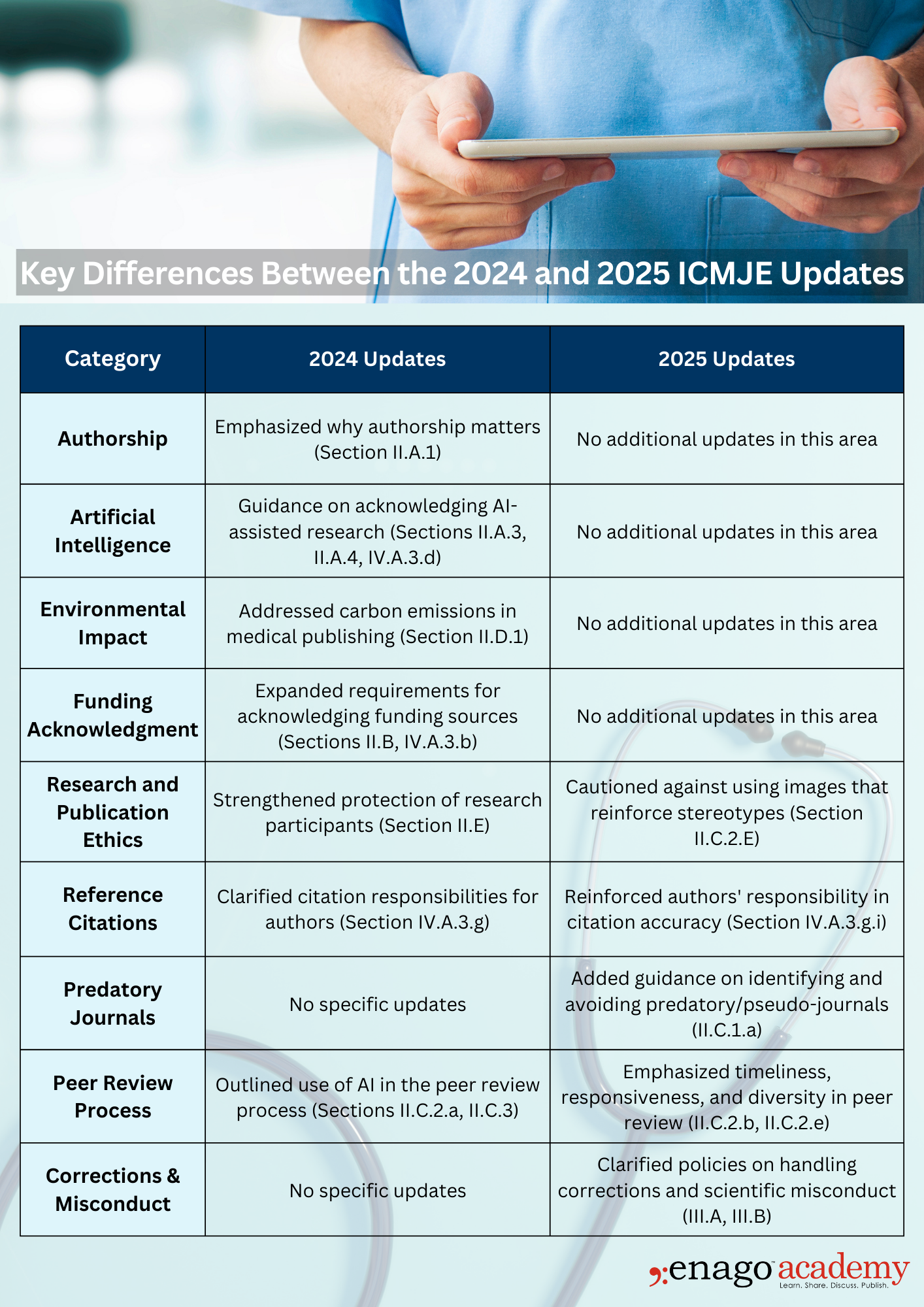
These revisions reflect the evolving landscape of research ethics and ethical publishing in scholarly communication. It is important for stakeholders to understand how these changes affect their roles and responsibilities, so that they can embrace and implement the guidance smoothly.
Below is a comprehensive decision tree to help authors adhere to the latest revisions of the ICMJE recommendations. The decision tree helps authors determine whether their manuscript adheres to key ICMJE guidelines for authorship, use of AI, disclosure of conflicts of interest, and data sharing.
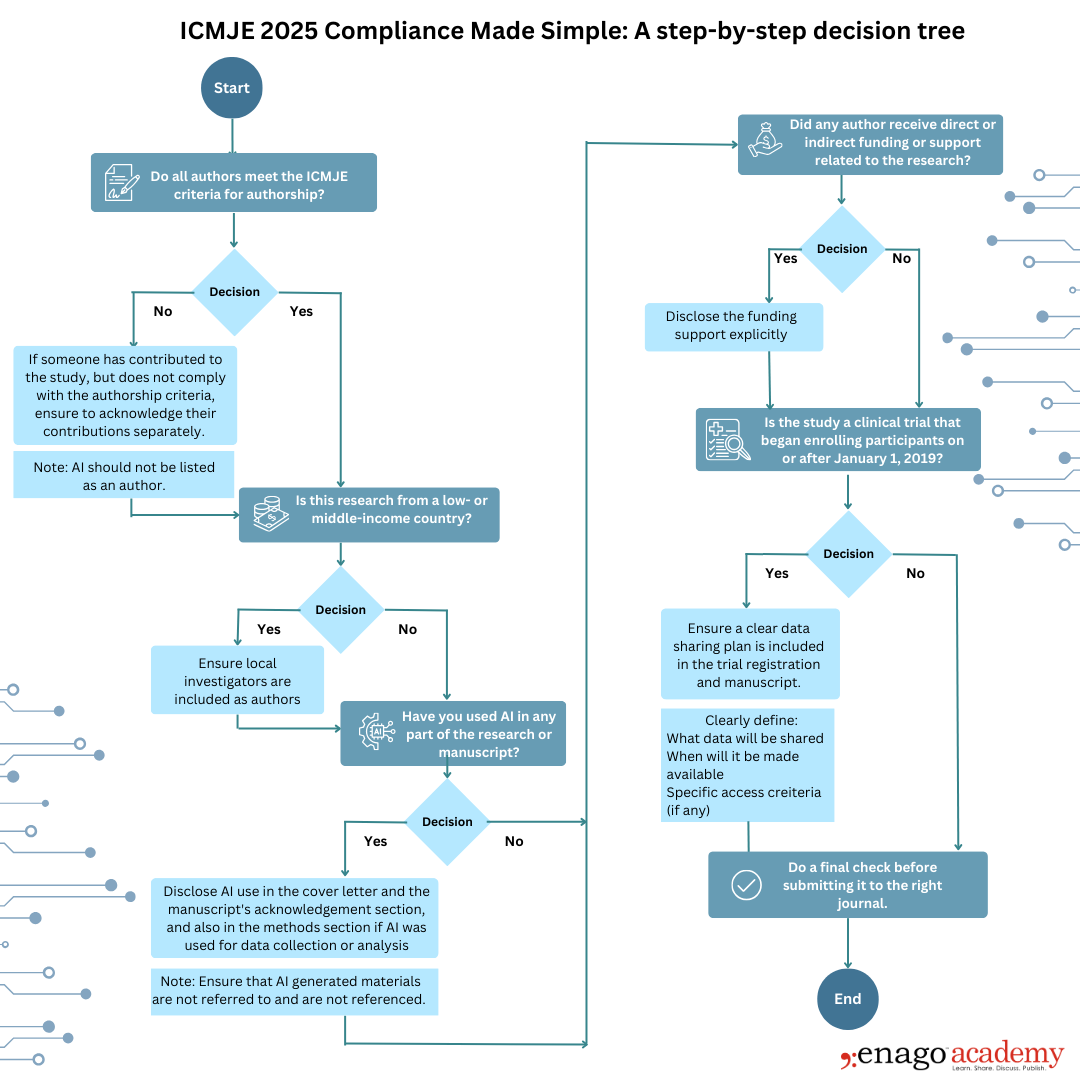
It is the responsibility of all stakeholders to understand and adhere to the ICMJE guidelines. Understanding and adhering to these guidelines contributes to maintaining research and publication ethics in medical and scientific publications. The ICMJE guidelines are continually being revised to address new challenges that are increasingly emerging in the field of publishing. By embracing these guidelines, researchers and editors can contribute to building a more transparent, trustworthy, and inclusive scientific literature.